Category: 42 Word Retrospectives

Charlie and the Chocolate Factory (1964)

Charlie and the Chocolate Factory

by Roald Dahl (George Allen & Unwin, 1964)

audiobook read by David Tennant (Penguin Audio, 2023)

Book cover: “Charlie and the Chocolate Factory” by Roald Dahl (George Allen & Unwin, 1964); audiobook read by David Tennant (Penguin Audio, 2023)

Gleeful and deranged, yet Dahl’s most famous novel is actually a bit of a mess, narrative-wise, establishing Charlie then elbowing him aside to revel in smudgelumptious flights of comeuppance and misopedic wish-fulfilment. David Tennant gives us one of the great Willy Wonkas.

Urn Burial

Urn Burial

by Kerry Greenwood (Penguin, 1996)

audiobook read by Stephanie Daniel (Bolinda, 2011)

Book cover: “Urn Burial” by Kerry Greenwood (Penguin, 1996); audiobook read by Stephanie Daniel (Bolinda, 2011)

Greenwood’s take on Golden Age manor-house murder mysteries plays merry with tropes. Phryne, while inscrutably piecing together the various puzzles, does very little with the revelations thus garnered, instead being swept along towards the denouement. Miss Mary Mead is a nice touch.

Squeeze Box

Squeeze Box

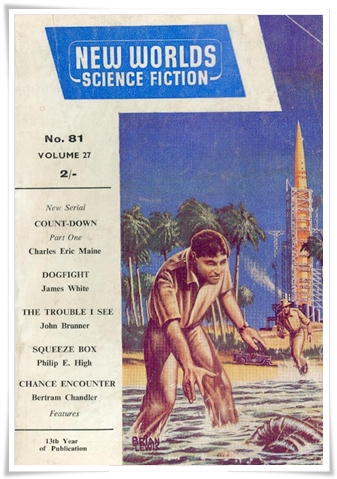
by Philip E. High (New Worlds, March 1959)

reprinted in “Isaac Asimov’s Wonderful Worlds of Science Fiction Invasions” ed. Isaac Asimov, Martin H. Greenberg & Charles G. Waugh (Roc, 1990), 350-364.

Magazine cover: New Worlds, March 1959; review of: “Squeeze Box” by Philip E. High, reprinted in “Isaac Asimov’s Wonderful Worlds of Science Fiction Invasions” ed. Isaac Asimov, Martin H. Greenberg & Charles G. Waugh (Roc, 1990), 350-364.

Workmanlike prose, artless storytelling, humanity triumphing (abruptly and at extreme odds) through dint of doughty everyman qualities and British wartime fortitude recrudescing at a species-wide level. Though lacking finesse, this alien invasion short story neatly captures High’s knack for imaginative SF wish-fulfilment.

The Monsters

The Monsters

by Robert Sheckley

The Magazine of Fantasy and Science Fiction, March 1953; reprinted in “Perilous Planets” ed. Brian Aldiss (Futura, 1980), 104-114.

Magazine cover: The Magazine of Fantasy and Science Fiction, March 1953; review of: “The Monsters” by Robert Sheckley, reprinted in “Perilous Planets” ed. Brian Aldiss (Futura, 1980), 104-114.

A slight tale, which Sheckley narrates from the casually parochial perspective of non-human protagonists, thus making the serious point that ‘humanity’ (or ‘normalcy’ in general) is very much species-centric. The prose is suitably lighthearted, the species differences artfully whimsical in their extremity.

Valérian and Laureline: Heroes of the Equinox

Valérian and Laureline: Heroes of the Equinox

by Jean-Claude Mézières & Pierre Christin (Hodder Dargaud, 1985)

[from “Les Héros de l’équinoxe”, 1978]

Graphic novel cover: “Valérian and Laureline: Heroes of the Equinox” by Jean-Claude Mézières & Pierre Christin (Hodder Dargaud, 1985) [from “Les Héros de l’équinoxe”, 1978]

Laureline is mostly sidelined, and even Valérian is relegated to fourth billing, a mooching Lucky Luke-type working through his imposter syndrome behind three SF-styled ideological archetypes representing Hindu mysticism, socialism, and aggressive capitalism. There remain some nice artwork intricacies and storytelling finesses.

“#ifdefDEBUG + ‘world/enough’ + ‘time’

#ifdefDEBUG + ‘world/enough’ + ‘time’

by Terry Pratchett

in “Digital Dreams” ed. David V. Barrett (New English Library, 1990), pp. 77-93.

Book cover: “Digital Dreams” ed. David V. Barrett (New English Library, 1990). Review of “#ifdefDEBUG + ‘world/enough’ + ‘time’” by Terry Pratchett, pp. 77-93.

Portable reality overlays. Knowledge/reality loss. Humans existing as data/virus. Deliberately murky in the execution? Perhaps somewhat ahead of its time conceptually, but Pratchett rather loses himself in the attempt to present an everyman voice (while still being a bit Pratchett-like and clever!).

The Story of Webster

The Story of Webster

by P. G. Wodehouse

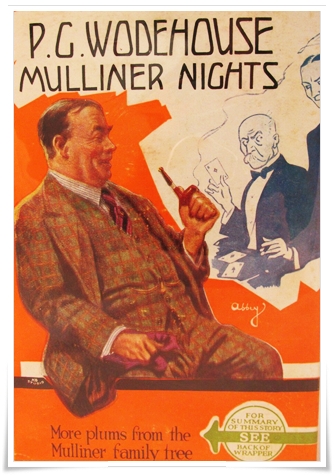
The American Magazine (February 1932); reprinted Mulliner Nights (Herbert Jenkins, 1933)

Book cover: Mulliner Nights by P. G. Wodehouse (Herbert Jenkins, 1933); review of: “The Story of Webster” by P. G. Wodehouse, The American Magazine (February 1932)

Like so many of Wodehouse’s ‘Mulliner’ stories, this comes across as a repurposed bit of business from a Bertie Wooster novel. The delivery is quintessential Wodehouse but there’s a nagging sense that the events described are taking place divorced of greater context. $466

The Dutch Shoe Mystery

The Dutch Shoe Mystery

by Ellery Queen (Gollancz, 1931)

audiobook read by Mark Peckham (Blackstone, 2013)

Book cover: “The Dutch Shoe Mystery” by Ellery Queen (Gollancz, 1931); audiobook read by Mark Peckham (Blackstone, 2013)

The third Ellery Queen mystery is just as personable but laborious as its predecessors. The clues are all there, the logic stacks up—save perhaps that the nurse was herself not seen coming or going—but remains buried in waffle and minutiae.

Topside

Topside

by Philip E. High

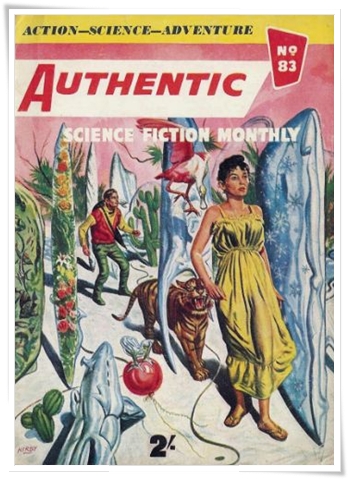
Authentic SF, No. 83 (August 1957), 58-77.

Magazine cover: Authentic SF, No. 83 (August 1957); review of: “Topside” by Philip E. High, pp. 58-77.

Lopsided short story which spends too long bringing its (seemingly all-male) cast out of suspended animation post-cataclysm, and not enough on their reclaiming Earth’s surface. Of interest primarily in comparison with High’s novel Sold – For a Spaceship, which does the job properly.

Derelict Space Sheep