Category: 42 Word Retrospectives

Tintin: The Black Island

Tintin: The Black Island

by Hergé (Methuen, 1966); trans. Leslie Lonsdale-Cooper & Michael Turner

Tintin_Black Island

The Boy’s Own adventuring kicks in on page one and doesn’t let up. Typical of the early volumes, Tintin tangles repeatedly with armed crooks and survives only through incredible luck and bravery, albeit that Hergé also pens a joyous outpouring of slapstick.


Planet of the Warlord

Planet of the Warlord

by Douglas Hill (Victor Gollancz, 1981)

Hill_Planet of the Warlord

A rousing conclusion to the Last Legionary quartet. Having re-established Keill Randor’s preternatural combat abilities, Hill plunges his protagonist into genuine defeat and despair, thence to rise again (aided by his alien friend Glr) and face one last set of impossible odds.


The Phantom Tollbooth

The Phantom Tollbooth

by Norton Juster; ill. Jules Feiffer (Epstein & Carroll, 1961)

Juster_Phantom Tollbooth

A fantastical middle-grade adventure full of warped notions and pun-based distortions of reality. Juster’s young protagonist is disinterested in the rigours of real-world learning but comes, through outlandish experience, to appreciate words and numbers. Feiffer’s illustrations prevent the dreamscape from becoming overwhelming.


The Cybil War

The Cybil War

by Betsy Byars (Viking Children’s, 1981)

Byars_Cybil War

A middle-grade story of first love, and of recognising and dealing with a toxic friendship. Byars grounds her writing with small details and the tragicomic ironies of real life. The result is downhearted yet somehow still easy to read, and ultimately cathartic.


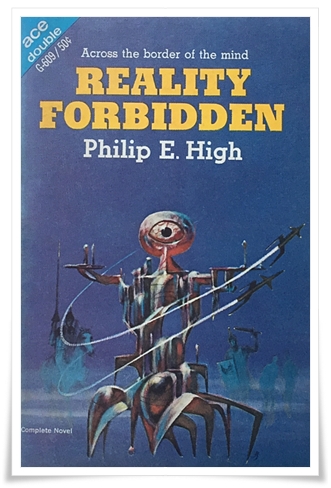
Reality Forbidden

Reality Forbidden

by Philip E. High (Robert Hale, 1967)

High_Reality Forbidden

A sinister, mind-rattling concept explored by the wrong author. High’s ideas are laid down seemingly as and when they occurred to him, which, even coming from the era of pulp, fails to impress. Eric Frank Russell would have made this a masterpiece.


The Valley of Fear

The Valley of Fear

by Arthur Conan Doyle (George H. Doran, 1915); audiobook read by Stephen Fry (ABC/Audible, 2018)

SONY DSC

In essence, two largely unconnected novellas. The first sees Holmes in fine form, his aura only enhanced by Inspector MacDonald’s shining a lesser light of uncommon strength. The second is an engaging enough story of Freemason gang activity in lawless north-east America.


The Gods Must Be Crazy II

The Gods Must Be Crazy II

dir. Jamie Uys (1989)

Uys_Gods Must Be Crazy II

Although lacking the surprise value and thematic elegance of the original, this sequel manages to be both faster and funnier, committing fully to its slapstick and the humorous situational comedy of non-natives adrift in the Kalahari. Cleverly filmed with many memorable scenes.


The Mystery of the Pantomime Cat

The Mystery of the Pantomime Cat

by Enid Blyton (Methuen, 1949)

Blyton_Mystery Pantomime Cat

One of the weaker Five Find-Outers books. Blyton recycles an earlier plot device and half-explored ethical point (the children manufacture false clues leading to and disrupting a real mystery investigation) while neglecting an obvious line of inquiry, which Bets belatedly tumbles to.


Tom’s Midnight Garden

Tom’s Midnight Garden

by Philippa Pearce (Oxford University Press, 1958); audiobook read by Jan Francis (AudioGO, 2012)

Pearce_Tom's Midnight Garden

Perhaps due to the time-slip nature of its story, Pearce’s Carnegie Medal–winning MG novel has aged well, unfolding simply and unhurriedly yet with lingering appeal. The wistful allure of Tom’s garden speaks to childhood wonder and the inevitability of growing up.


Derelict Space Sheep