Category: 42 Word Retrospectives

Butterfly Planet

Butterfly Planet

by Philip E. High (Hale, 1971)

High_Butterfly Planet

High’s prose is slapdash, his grammar shaky and his punctuation atrocious. His wealth of SF ideas offers some compensation but these gush forth as if from a newly struck oil well. Only having laid claim does High refine them (in subsequent novels).


After the Goat Man

After the Goat Man

by Betsy Byars (The Bodley Head, 1974)

Byars_After the Goat Man

A remarkable middle grade novel. By delving deep into the protagonists’ wistful ruminations—especially poor overweight Harold’s—Byars not only guides her characters to a precocious philosophical maturity (cf. Peanuts) but also holds the reader’s attention despite there being almost no plot.


Hood’s Army: Earth Invaded

Hood’s Army: Earth Invaded

by Nathan Elliott (Dragon Books, 1986)

Elliott_Earth Invaded

Uncomplicated and fast-moving, this first book of Elliott’s middle-grade SF trilogy recalls the action machismo of Flash Gordon (with touches of Robin Hood). There’s nothing subtle about the invasion narrative or male-minded response. The robot AMOS, however, offers a point of uniqueness.


The Stranger, Series 1

The Stranger, Series 1

by G. K. Saunders; dir. Gil Brealey (ABC, 1964)

Stranger 01

Early Australian SF. A cagey alien befriends three schoolchildren while seeking refugee status for his people. The Stranger is played seriously and contrives across six episodes (particularly through its incidental music) to maintain a sense of ambiguity vis-à-vis the extra-terrestrials’ true intentions.


The Invaders Plan

Mission Earth #1: The Invaders Plan

by L. Ron Hubbard (New Era, 1985)

Hubbard_Invaders Plan

Hubbard wrote SF in a pulp style. While Mission Earth on the one hand offers a memorably characterised satire, on the other it is an insubstantial and oddly distasteful wad of fairy floss. Each chapter rattles along but very little actually happens.


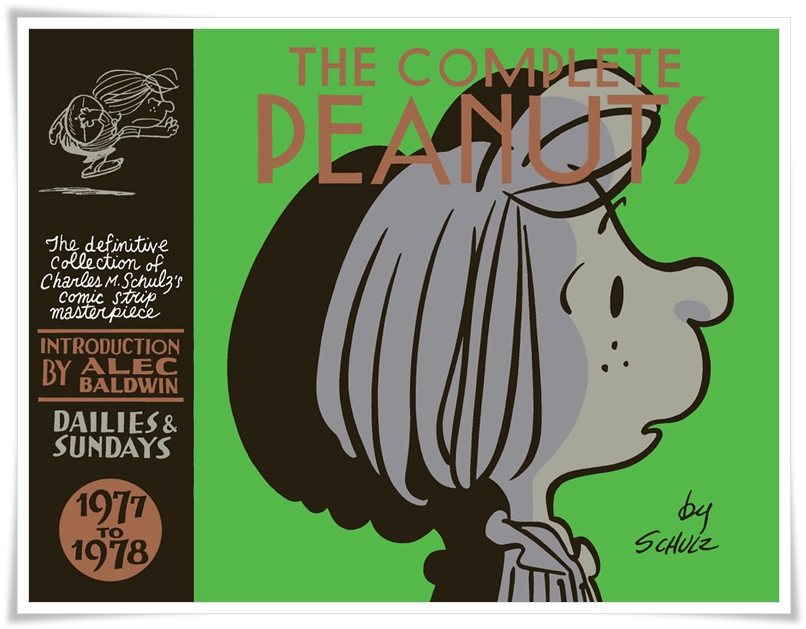
The Complete Peanuts: 1993 to 1994

The Complete Peanuts: 1993 to 1994

by Charles M. Schulz (Fantagraphics Books, 2014)

Schulz_Complete Peanuts 1993-1994

Spurred perhaps by Rerun’s belated coming of age, Schulz bestows upon the Peanuts gang some nice little touches of character growth (Charlie Brown’s more active pursuit of the Little Red-Haired Girl, for instance). Unfortunately, his once-consummate penmanship is starting to look shaky.


Lucky Luke: Billy the Kid

Lucky Luke: Billy the Kid

by Morris & Goscinny, trans. Luke Spear (Cinebook Ltd, 2006) [Original French language version published in Spirou magazine, 1962]

Morris_Goscinny_Billy the Kid

Morris’ illustrations are as playful as ever but Goscinny’s script lacks the usual sparkle, overmuch being made of the central conceit (ie. that notorious outlaw Billy the Kid is an actual child) and in-story repetitions similar to those in Goscinny’s Asterix stories.


A Lemon-Yellow Elephant called Trunk

A Lemon-Yellow Elephant called Trunk

by Barbara Softly; ill. Tony Veale (Chatto, Boyd & Oliver, 1971)

Softly_Lemon-Yellow Elephant

What seems at first a tale of whimsy turns instead into a rather clumsily executed parable of individual worth and acceptance. Thankfully Tony Veale draws a creditable elephant (and round-snouted giraffes). The floating artwork and limited use of colours leave an impression.


Neuromancer

Neuromancer

by William Gibson (Ace, 1984); audiobook read by Jeff Harding (Bolinda, 2014)

Gibson_Neuromancer

Though ground-breaking, Neuromancer in retrospect seems more a writers’ guide for cyberpunk than a fully-fledged work, its constituent parts being 5% plot, 35% characterisation and 60% overlay. Appreciation of the audiobook will depend largely on one’s tolerance for Harding’s hardboiled noir drawl.


Derelict Space Sheep