Category: 42 Word Retrospectives

The Stranger, Series 1

The Stranger, Series 1

by G. K. Saunders; dir. Gil Brealey (ABC, 1964)

Stranger 01

Early Australian SF. A cagey alien befriends three schoolchildren while seeking refugee status for his people. The Stranger is played seriously and contrives across six episodes (particularly through its incidental music) to maintain a sense of ambiguity vis-à-vis the extra-terrestrials’ true intentions.



The Invaders Plan

Mission Earth #1: The Invaders Plan

by L. Ron Hubbard (New Era, 1985)

Hubbard_Invaders Plan

Hubbard wrote SF in a pulp style. While Mission Earth on the one hand offers a memorably characterised satire, on the other it is an insubstantial and oddly distasteful wad of fairy floss. Each chapter rattles along but very little actually happens.


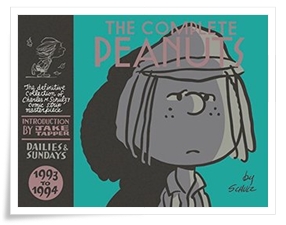
The Complete Peanuts: 1993 to 1994

The Complete Peanuts: 1993 to 1994

by Charles M. Schulz (Fantagraphics Books, 2014)

Schulz_Complete Peanuts 1993-1994

Spurred perhaps by Rerun’s belated coming of age, Schulz bestows upon the Peanuts gang some nice little touches of character growth (Charlie Brown’s more active pursuit of the Little Red-Haired Girl, for instance). Unfortunately, his once-consummate penmanship is starting to look shaky.


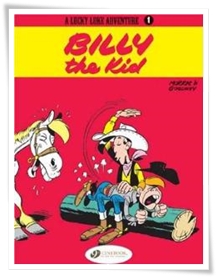
Lucky Luke: Billy the Kid

Lucky Luke: Billy the Kid

by Morris & Goscinny, trans. Luke Spear (Cinebook Ltd, 2006) [Original French language version published in Spirou magazine, 1962]

Morris_Goscinny_Billy the Kid

Morris’ illustrations are as playful as ever but Goscinny’s script lacks the usual sparkle, overmuch being made of the central conceit (ie. that notorious outlaw Billy the Kid is an actual child) and in-story repetitions similar to those in Goscinny’s Asterix stories.


A Lemon-Yellow Elephant called Trunk

A Lemon-Yellow Elephant called Trunk

by Barbara Softly; ill. Tony Veale (Chatto, Boyd & Oliver, 1971)

Softly_Lemon-Yellow Elephant

What seems at first a tale of whimsy turns instead into a rather clumsily executed parable of individual worth and acceptance. Thankfully Tony Veale draws a creditable elephant (and round-snouted giraffes). The floating artwork and limited use of colours leave an impression.


The Complete Peanuts: 1961 to 1962

The Complete Peanuts: 1961 to 1962

by Charles M. Schulz (Fantagraphics Books, 2006)

Schulz_Complete Peanuts 1961-1962

By the early 60s, Schulz has more or less perfected his Peanuts strip: droll adult wit filtered through the eyes and actions of children (plus the irrepressible Snoopy) and interspersed with tour-de-force visual humour. This is a particularly good volume for Linus.


Neuromancer

Neuromancer

by William Gibson (Ace, 1984); audiobook read by Jeff Harding (Bolinda, 2014)

Gibson_Neuromancer

Though ground-breaking, Neuromancer in retrospect seems more a writers’ guide for cyberpunk than a fully-fledged work, its constituent parts being 5% plot, 35% characterisation and 60% overlay. Appreciation of the audiobook will depend largely on one’s tolerance for Harding’s hardboiled noir drawl.


The Downhill Crocodile Whizz

The Downhill Crocodile Whizz and Other Stories

by Margaret Mahy; ill. Jon Riley (Puffin, 1987)

Mahy_Downhill Crocodile Whizz

The lead story doesn’t do justice to this collection. Where ‘The Downhill Crocodile Whizz’ is merely frivolous, the nine subsequent tales offer imagination of substance, combining fairy-tale whimsy with offbeat social observations and gently eccentric worldbuilding. Jon Riley’s illustrations egg the pudding.


Transformers: The Movie

Transformers: The Movie

dir. Nelson Shin (1986)

Shin_Transformers the Movie

A truly execrable piece of stream-of-consciousness filmmaking, taking the very worst aspects of television cartoons, action movies, Japanese SF, the 1980s (in general) and synth-metal fusion soundtracks (in gruelling particular) and throwing them together with disastrous effect. No wonder Orson Welles died.


Derelict Space Sheep