Category: 42 Word Retrospectives

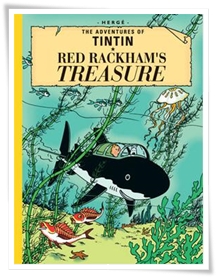
Tintin: Red Rackham’s Treasure

Tintin: Red Rackham’s Treasure

by Hergé (Le Soir, 1943); trans. Leslie Lonsdale-Cooper & Michael Turner (Methuen, 1959)
Herge_Red Rackham's Treasure

A Tintin adventure with no villain! Hergé plays on readers’ expectations of peril but casts aside the usual death-defying storylines, netting instead a string of uncommonly dégagé Caribbean escapades. Red Rackham’s Treasure, though undemanding, gleams yet with well-plotted, vivaciously rendered humour. Exemplary.


The Complete Peanuts: 1971 to 1972

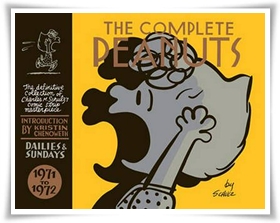
The Complete Peanuts: 1971 to 1972

by Charles M. Schulz (Fantagraphics Books, 2009)

Schulz_Complete Peanuts 1971-1972

An evocatively drawn mix of wit, whimsy and preternatural wisdom. Poor old wishy-washy Charlie Brown remains the unifying figure but there are a good number of delightfully droll (and character-defining) strips involving Peppermint Patty, Sally Brown, and in particular Lucy van Pelt.


The Long Dark Tea-Time of the Soul

The Long Dark Tea-Time of the Soul

by Douglas Adams (William Heinemann, 1988); audiobook read by Douglas Adams (Phoenix, 2015)

Adams_Long Dark Tea-Time of the Soul

The story, when looked back upon at book’s end, turns out to have been the flimsiest of nonsense. Dirk actually does very little. But this only serves to emphasise the deft, droll, audacious touch of Adams’ whimsy, and the lure of interconnectedness.


The Rockingdown Mystery

The Rockingdown Mystery

by Enid Blyton (William Collins, 1949)

Blyton_Rockingdown Mystery

A solid introduction to the ‘Barney’ (or ‘R’) mystery series. Standard Blyton characters Roger and Diana are superseded by their mischievous cousin Snubby, vagabond circus boy Barney and his monkey Miranda, and of course Snubby’s (actually Blyton’s daughters’) memorably madcap dog Loony.


The Mummy Case

The Mummy Case

by Elizabeth Peters (Congdon & Weed, 1985); audiobook read by Susan O’Malley (Blackstone, 1999)

Peters_Mummy Case

Although the mystery is not investigated in any meaningful way, Peters’ knowledge of Egyptology adds depth and her narrative is quietly amusing. Susan O’Malley’s audiobook reading bears suitable record of Amelia Peabody, Emerson, and the precocious wunderkind Ramses, preserving their dignified foolery.


The Neverending Story

The Neverending Story

by Michael Ende (Thienemann Verlag, 1979); trans. Ralph Manheim; audiobook read by Gerard Doyle (Tantor, 2012)

Ende_Neverending Story

Fantastica is aptly named and the fantasy adventure gains an extra edge of wonder by having its fictional reader incorporated into the story. Where the film version ends, however, the book morphs into a didactic quest narrative and plods on, seemingly forever!


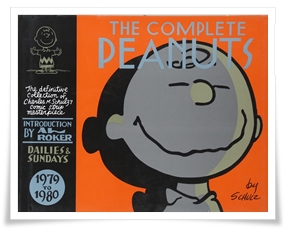
The Complete Peanuts: 1979 to 1980

The Complete Peanuts: 1979 to 1980

by Charles M. Schulz (Fantagraphics Books, 2011)

Schulz_Complete Peanuts 1979-1980

An excellent vintage. As well as his usual pithy one-offs, Schulz presents several week-long serials and even one month-long epic. Peppermint Patty comes particularly to the fore, validating the claim that she could have sustained a comic strip in her own right.


The Metamorphosis

The Metamorphosis

by Franz Kafka (Kurt Wolff Verlag, 1915); audiobook read by Benedict Cumberbatch (Bolinda, 2018)

Kafka_Metamorphosis

Kafka seemingly cuts straight to the point in this simply written, somewhat overrated novella, but in truth Gregor Samsa’s metamorphosis remains open to numerous interpretations (beyond the story at face value, which also serves). Benedict Cumberbatch’s reading makes the audiobook more palatable.


The Dark Lord of Derkholm

The Dark Lord of Derkholm

by Diana Wynne Jones (Gollancz, 1998); audiobook read by Jonathan Broadbent (Clipper, 2013)

Jones_Dark Lord Derkholm

The concept is clever—explaining at last the genre-wide recrudescence of fantasy dark lords!—and Derk and Mara’s human-griffin family makes a pleasing point of (embracing) difference. The story itself, however, merely demonstrates cliché, dragging, meandering and bloviating to no great purpose.


The Picture of Dorian Gray

The Picture of Dorian Gray

by Oscar Wilde (Lippincott’s Monthly Magazine, 1890); audiobook read by Steven Crossley (W F Howes, 2012)

Wilde_Dorian Gray

The story is justly famous and the epigrams easy to quote, yet the overall reading experience is rendered wearisome by Wilde’s tacked-on (and continuously hammered home) cod philosophy. The character of Sir Henry presumably inspired that of The Sphinx in Mystery Men.


Derelict Space Sheep