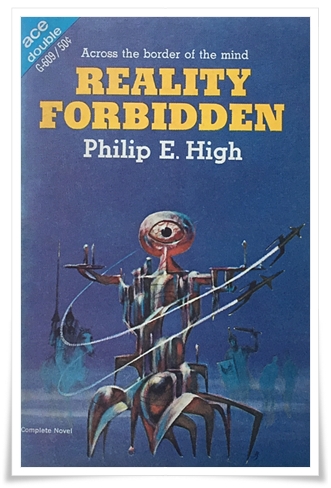
Tag: Philip E. High

Guess Who?

Guess Who?

by Philip E. High

New Worlds Science Fiction, Vol. 19, No. 56 (February 1957), 88-99.
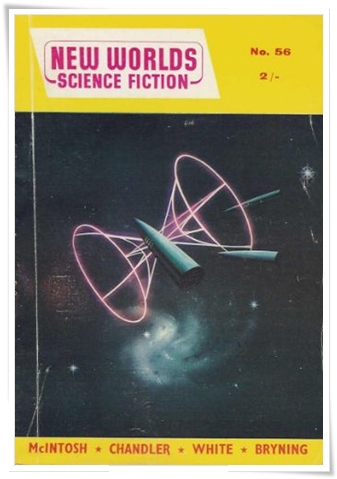
Magazine cover: New Worlds Science Fiction, Vol. 19, No. 56 (February 1957); review of “Guess Who?” by Philip E. High, pp. 88-99.

SF short story in which High attempts to show up the military’s hard-ball pre-emptive aggression while also postulating how to deal with a ruthless species of telepathic shape-changers—an odd juxtaposition, as the latter come across as no better than the former.

Survival Course

Survival Course

by Philip E. High, New Worlds Science Fiction, No. 11, Vol. 38 (December 1961), 41-58.

Magazine cover: New Worlds Science Fiction, No. 11, Vol. 38 (December 1961); review of “Survival Course” by Philip E. High, pp. 41-58.

A rare foray into first-personal narrative for High. This short story reads more naturally than much of his writing, and the SF idea is as imaginative as ever—albeit with little on show beyond the portrayal of concept (a uniquely hostile lifeform).

Squeeze Box

Squeeze Box

by Philip E. High (New Worlds, March 1959)

reprinted in “Isaac Asimov’s Wonderful Worlds of Science Fiction Invasions” ed. Isaac Asimov, Martin H. Greenberg & Charles G. Waugh (Roc, 1990), 350-364.

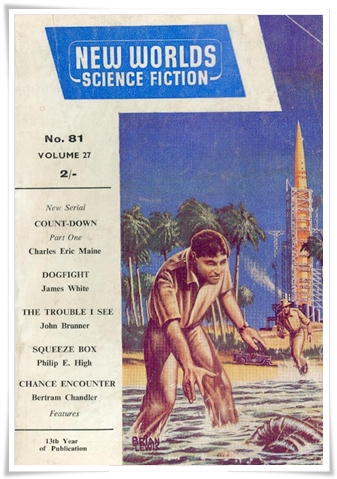
Magazine cover: New Worlds, March 1959; review of: “Squeeze Box” by Philip E. High, reprinted in “Isaac Asimov’s Wonderful Worlds of Science Fiction Invasions” ed. Isaac Asimov, Martin H. Greenberg & Charles G. Waugh (Roc, 1990), 350-364.

Workmanlike prose, artless storytelling, humanity triumphing (abruptly and at extreme odds) through dint of doughty everyman qualities and British wartime fortitude recrudescing at a species-wide level. Though lacking finesse, this alien invasion short story neatly captures High’s knack for imaginative SF wish-fulfilment.

Topside

Topside

by Philip E. High

Authentic SF, No. 83 (August 1957), 58-77.

Magazine cover: Authentic SF, No. 83 (August 1957); review of: “Topside” by Philip E. High, pp. 58-77.

Lopsided short story which spends too long bringing its (seemingly all-male) cast out of suspended animation post-cataclysm, and not enough on their reclaiming Earth’s surface. Of interest primarily in comparison with High’s novel Sold – For a Spaceship, which does the job properly.

The Mad Metropolis

The Mad Metropolis

by Phillip E. High (Ace, 1966)

reprinted as “Double Illusion” (Dobson, 1970)

Book covers: “The Mad Metropolis” by Phillip E High (Ace, 1966); reprinted as “Double Illusion” (Dobson, 1970)

While the central premise remains relevant—humanity entrusting itself to an AI but installing a kill switch that sends it crazy—High’s execution is amateurish, adding layer after extraneous, unpolished layer to turn an intriguing short story idea into a flabby novel.

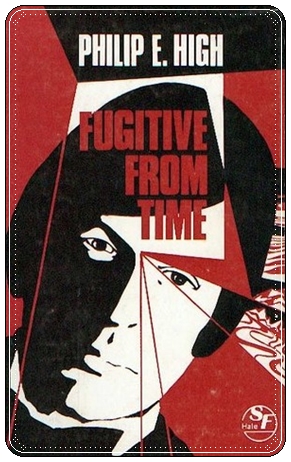
Fugitive From Time

Fugitive From Time

by Philip E. High (Hale, 1978)

High_Futitive From Time

High’s novels were too often marred by instalove and sparse, wince-inducing female representation. His wellspring of SF ideas, however, cannot help but fire the imagination. Fugitive From Time is a fever dream of implacable alien menace, anti-war imagery and humanity’s metamorphosic coming-of-age.


Sold – For a Spaceship

Sold – For a Spaceship

by Philip E High (Robert Hale, 1973)

High_Sold for a Spaceship

High deploys his customary optimism in having the remnants of the human race awake from suspended animation to reclaim their much-changed planet. An enjoyable helter-skelter hodgepodge of pulp SF ideas, characters and landscapes, marred by male-female interactions that are early Hollywood cringeworthy.


Butterfly Planet

Butterfly Planet

by Philip E. High (Hale, 1971)

High_Butterfly Planet

High’s prose is slapdash, his grammar shaky and his punctuation atrocious. His wealth of SF ideas offers some compensation but these gush forth as if from a newly struck oil well. Only having laid claim does High refine them (in subsequent novels).


Derelict Space Sheep