Category: 42 Word Retrospectives

The Return of Dr. Fu-Manchu (1916)

The Return of Dr. Fu-Manchu

by Sax Rohmer (Robert M. McBride & Company, 1916)

audiobook read by John Bolen (Tantor, 2009)

Book cover: “The Return of Dr. Fu-Manchu” by Sax Rohmer (Robert M. McBride & Company, 1916); audiobook read by John Bolen (Tantor, 2009)

Stitched-together short stories, none especially gripping. The racial depiction of Fu Manchu isn’t so problematic as the sledgehammered assertion of villainy, which itself is nothing compared to Petrie’s besotted witterings re Kâramanèh. Bolen reads as if auditioning for a Bertie Wooster gig.

Ruddy Gore

Ruddy Gore

by Kerry Greenwood (McPhee Gribble, 1995)

audiobook read by Stephanie Daniel (Bolinda, 2010)

Book cover: “Ruddy Gore” by Kerry Greenwood (McPhee Gribble, 1995); audiobook read by Stephanie Daniel (Bolinda, 2010)

A light mystery that mostly solves itself, under cover of Daniel’s poised audiobook reading and the infectious enthusiasm carried over by Greenwood from her copious research into 1920s Melbourne (especially Chinese immigrant culture), the theatre and Gilbert & Sullivan (Ruddigore in particular).

The Not-Just-Anybody Family

The Not-Just-Anybody Family

by Betsy Byars (The Bodley Head, 1986)

audiobook read by Blain Fairman (Books on Tape, 2008)

Book cover: “The Not-Just-Anybody Family” by Betsy Byars (The Bodley Head, 1986); audiobook read by Blain Fairman (Books on Tape, 2008)

A cleverly executed MG novel. Things mostly go wrong for the protagonists—a seven-year-old boy, his 11-year-old brother and sister, their grandpa and his dog—but their travails are told with humour and they come away with a deeper appreciation of family.

Human Man’s Burden

Human Man’s Burden

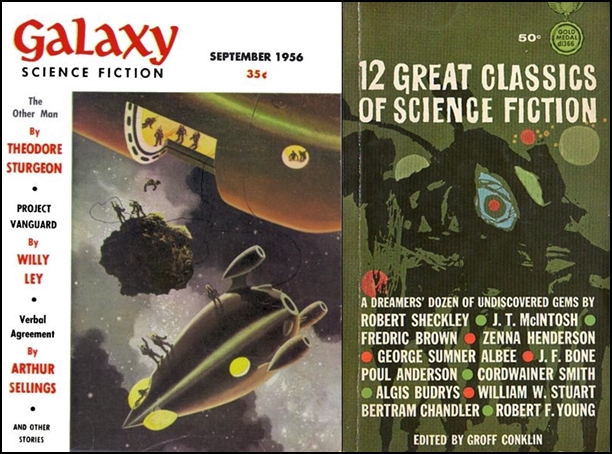
by Robert Sheckley, Galaxy Science Fiction (September, 1956)

reprinted 12 Great Classics of Science Fiction, ed. Groff Conklin (Fawcett, 1963), pp. 57-71.

Magazine cover: Galaxy Science Fiction (September, 1956).
Book cover: 12 Great Classics of Science Fiction, ed. Groff Conklin (Fawcett, 1963); review of “Human Man’s Burden” by Robert Sheckley, pp. 57-71.

A disarming little story that, in setting itself up as a comedy, appears to make one point about men, women and the human condition, switches as if to make another, then turns out to have been about robot sentience and master/slave dynamics.

The Door

The Door

by Eric Frank Russell, Universe Science Fiction #4 (March 1954), pp. 6-17.

Magazine cover: Universe Science Fiction #4 (March 1954); review of: “The Door” by Eric Frank Russell, pp. 6-17.

A plotless short story likening career spacers to lovelorn young men grown old in service to the Foreign Legion. Russell pitches this as a SF fairy tale, but the framing narrative is awkward and the voice offers nothing of his usual personality.

Asterix the Gladiator

Asterix the Gladiator

by Goscinny & Uderzo (Pilote, 1961-1962); trans. Anthea Bell & Derek Hockridge (Hodder & Stoughton, 1969)

Book cover: “Asterix the Gladiator” by Goscinny & Uderzo (Pilote, 1961-1962); trans. Anthea Bell & Derek Hockridge (Hodder & Stoughton, 1969)

A glorious plethora of puns and running gags, built around the conceit of Cacofonix the bard being kidnapped as a gift for Caesar. The physical humour is delightful (as always), and all the characters brim with personality, the historical setting exquisitely realised.

Tintin: King Ottokar’s Sceptre

Tintin: King Ottokar’s Sceptre

by Hergé (Le Petit Vingtième, 1938-1939); re-drawn in colour (Casterman, 1947); trans. Leslie Lonsdale-Cooper & Michael Turner (Methuen, 1958)

Book cover: “Tintin: King Ottokar’s Sceptre” by Hergé (Le Petit Vingtième, 1938-1939); re-drawn in colour (Casterman, 1947); trans. Leslie Lonsdale-Cooper & Michael Turner (Methuen, 1958)

Not as coherent as some of the later Tintin stories, nor as sublimely threaded with humour—though the Thom(p)son twins do offer some light relief from the conspiracy plot and death-defying Boy’s Own antics. Hergé’s attention to artistic detail continues to amaze.

The Empire Strikes Back

The Empire Strikes Back

dir. Irvin Kershner (1980)

Film poster: “The Empire Strikes Back” dir. Irvin Kershner (1980)

A remarkably satisfying feature, given that it’s mostly set-up for Return of the Jedi. The few thematic developments seem rushed, but the crises are compelling and the action and humour remain on-point. Yoda debuts as one of the all-time great film characters.

The Clock Strikes Twelve

The Clock Strikes Twelve

by Patricia Wentworth (J. B. Lippincott, 1944)

audiobook read by Diana Bishop (Isis, 2010)

Book cover: “The Clock Strikes Twelve” by Patricia Wentworth (J. B. Lippincott, 1944); audiobook read by Diana Bishop (Isis, 2010)

Wentworth cheats a little by employing an expurgated omniscient narrative to deflect attention. The ever-coughing Miss Silver is like a cuddly Miss Marple, and has the distinction of solving the murder as she goes, rather than keeping mum for a big reveal.

A Monstrous Regiment of Women

A Monstrous Regiment of Women

by Laurie R. King (St. Martin’s Press, 1995)

audiobook read by Jenny Sterlin (Clipper, 1996)

Book cover: “A Monstrous Regiment of Women” by Laurie R. King (St. Martin’s Press, 1995); audiobook read by Jenny Sterlin (Clipper, 1996)

King presents an earnest and edifying depiction of women’s struggle for recognition, rights and self-governance after the First World War. This backdrop, however, comes rather at the expense of Mary, who exchanges precocious Sherlockian competence for a dubious arc of emotional growth.

Derelict Space Sheep