Category: 42 Word Retrospectives

Clouds of Witness

Clouds of Witness

by Dorothy L. Sayers (T. Fisher Unwin, 1926); audiobook read by Ian Carmichael (BBC, 1992/2009)

Sayers_Clouds of Witness

An unhurried mystery from which the protagonist seems oddly removed. Lord Peter Wimsey is a character cut from the Wodehouse mould, yet the writing—despite its occasionally witty turn of phrase—leaves him untethered, a whimsy (as it were) without true purpose.


Rumpole of the Bailey

Rumpole of the Bailey

by John Mortimer (Penguin, 1978); audiobook read by Robert Hardy (Bolinda, 2014)

Mortimer_Rumpole of the Bailey

Based on the TV series, this book is as much about the tribulations as the trials of Horace Rumpole, an eccentric and oft-thwarted, poetry-quoting English barrister. Rumpole’s wins may be pyrrhic at best, but are humorously bolstered by his free-flowing, sardonic ruminations.


The Big Lebowski

The Big Lebowski

dir. Joel Coen (1998)

Coen_Big Lebowski

The Big Lebowski shouldn’t work—the script is indulgent, the kidnapping/ransom plot meanders convolutedly—yet somehow it does. Jeff Bridges is unforgettable as The Dude (a mellow but acerbic hippie), backed by John Goodman as his Vietnam War- and bowling-obsessed friend.


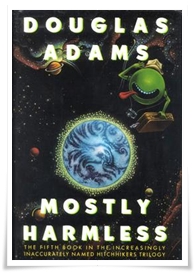
Mostly Harmless

Mostly Harmless

by Douglas Adams (William Heinemann, 1992); audiobook read by Martin Freeman (Bolinda, 2006)

Adams_Mostly Harmless

An ingeniously plotted novel—by far the most coherent of the Hitchhiker’s books—and one in which Adams at last paid attention to characterisation; but the effect is spoiled somewhat by an incongruous (if by then expected) jokiness in the prose style.


Doctor Who: Corpse Marker

Doctor Who: Corpse Marker

by Chris Boucher (BBC, 1999); audiobook read by David Collings (BBC, 2015)

Boucher_Corpse Marker

Back in the late 1970s Chris Boucher established the character of Leela, wrote the classic Doctor Who story The Robots of Death, and script-edited Blake’s 7. Little surprise, then, that his robots sequel Corpse Marker showcases the better qualities of all three.


Hitler’s Daughter

Hitler’s Daughter

by Jackie French (HarperCollins, 1999); audiobook read by Caroline Lee (Bolinda, 2014)

French_Hitler's Daughter

The framing narrative of this cleverly structured middle grade book sees three rural Aussie kids sharing a story while waiting for their school bus. The tale of Hitler’s daughter raises the disturbing question: should children be held responsible for their parents’ beliefs.


Doctor Who: The Ribos Operation

Doctor Who: The Ribos Operation

by Ian Marter (Target, 1979); audiobook read by John Leeson (Chivers, 2011)

Marter_Ribos Operation

As a TV serial ‘The Ribos Operation’ is respected for its production values, script and performances. As a novelisation it becomes saggy and tedious. Wholehearted writer Ian Marter assiduously seizes every conceivable opportunity to unerringly inject knee-hammer adjectives and slavishly conceived adverbs.


The Return of Sherlock Holmes

The Return of Sherlock Holmes

by Sir Arthur Conan Doyle (George Newnes, 1905); audiobook read by Stephen Fry (ABC, 2017)

Conan Doyle_Return of Sherlock Holmes

Stephen Fry takes seriously the task of voicing Conan Doyle’s stories, yet with faint echoes of his own comedic characters seeping through (in contrast sufficient to add further gravitas to the great detective). Sherlock Holmes resumes practice post-Reichenbach, as superior as ever.


George’s Marvellous Medicine

George’s Marvellous Medicine

by Roald Dahl (Jonathan Cape, 1981); audiobook read by Derek Jacobi (Penguin, 2013)

Dahl_George's Marvellous Medicine

Despite this being one of Dahl’s less substantial (yet somehow belaboured) stories, the freewheeling absurdity of George’s concoction and the subsequent karmic comeuppance to his grandma will appeal to middle grade readers. Derek Jacobi narrates with the glee of a mischievous grandparent.


Derelict Space Sheep