Tag: Robert Sheckley

Human Man’s Burden

Human Man’s Burden

by Robert Sheckley, Galaxy Science Fiction (September, 1956)

reprinted 12 Great Classics of Science Fiction, ed. Groff Conklin (Fawcett, 1963), pp. 57-71.

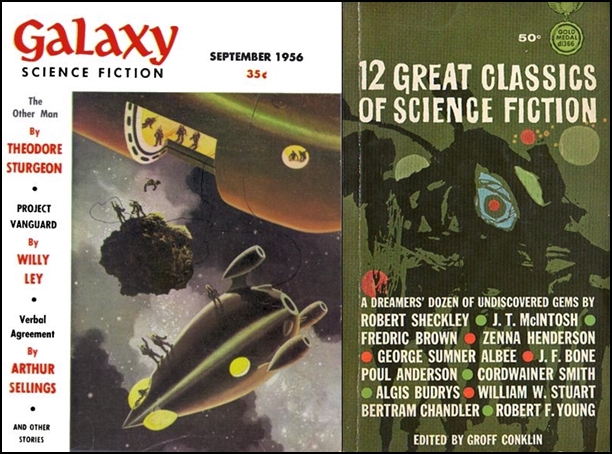
Magazine cover: Galaxy Science Fiction (September, 1956).
Book cover: 12 Great Classics of Science Fiction, ed. Groff Conklin (Fawcett, 1963); review of “Human Man’s Burden” by Robert Sheckley, pp. 57-71.

A disarming little story that, in setting itself up as a comedy, appears to make one point about men, women and the human condition, switches as if to make another, then turns out to have been about robot sentience and master/slave dynamics.

All the Things You Are

All the Things You Are

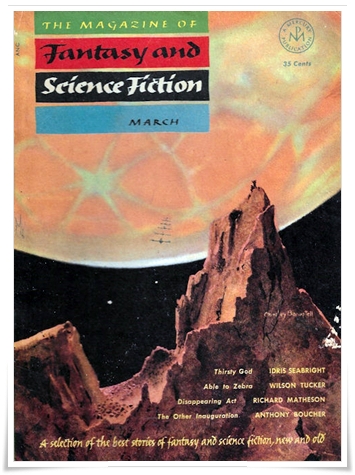
by Robert Sheckley, Galaxy (July 1956); UK edition no. 42 (September 1956), 118-128.

Magazine Cover: Galaxy (July 1956); UK edition no. 42 (September 1956); review of , 118-128.

A humorous if inconsequential short story from that once-thriving SF subgenre wherein civilised Earth crews in their technologically advanced ships go rocketing about the galaxy, abjectly messing up first contact with more primitive peoples. Funny enough, without rising to any great heights.

Hands Off

Hands Off

by Robert Sheckley

Galaxy Science Fiction (April, 1954); UK No. 18 (September, 1954), pp. 54-63.

Magazine cover: Galaxy Science Fiction (April, 1954); review of “Hands Off” by Robert Sheckley”, UK No. 18 (September, 1954), pp. 54-63.

SF novelette offering a two-pronged narrative, following the actions firstly of an unscrupulous human pirate crew, and secondly of the principled alien whose near-totally incompatible physical makeup renders it impossible for them to steal his spaceship. A whimsical, waggish tale of comeuppance.

Protection

Protection

by Robert Sheckley

Galaxy Science Fiction (April, 1956); UK No. 39 (June, 1956), pp. 54-63.

Magazine cover: Galaxy Science Fiction (April, 1956); UK No. 39 (June, 1956); review of “Protection” by Robert Sheckley, pp. 54-63.

One of those technically insubstantial Sheckley short stories that nevertheless skims along with sufficient comedic insouciance to qualify as a good read. The protagonist accepts an alien protection service, just because it’s free, but in doing so brings about his own undoing.

A Thief in Time

A Thief in Time

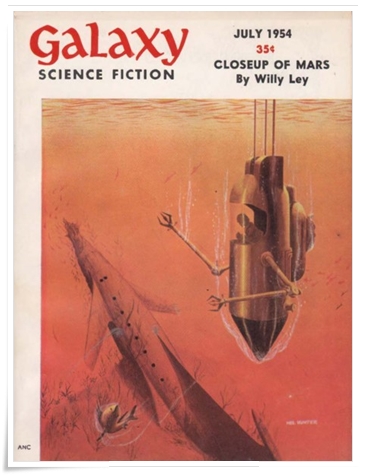
by Robert Sheckley, Galaxy Science Fiction (July, 1954); UK No. 21 (December, 1954), pp. 4-27.

Magazine cover: Galaxy Science Fiction (July, 1954); UK No. 21 (December, 1954); review of “A Thief in Time” by Robert Sheckley, UK edition, pp. 4-27.

A light-hearted romp but the time travel paradox isn’t explored so much as indulged in, ad hoc, until (it feels) Sheckley rollicked his word count up to novelette length and the editor had enough pages filled to put a stop to it.

Keep Your Shape

Keep Your Shape

by Robert Sheckley

Galaxy Science Fiction (November, 1953); UK No. 13 (April 1954), pp. 4-20.

Magazine cover: Galaxy Science Fiction (November, 1953); UK No. 13 (April 1954); review of “Keep Your Shape” by Robert Sheckley, pp. 4-20.

Humorous SF invasion short story with philosophical undertones. Sheckley posits a race of shapechangers whose oppressive caste system limits each individual to a prescribed set of forms. Confronted with Earth’s biological diversity, the disgruntled lower echelons exhibit a tendency to go native!

Masters of Science Fiction: Robert Sheckley

Masters of Science Fiction: Robert Sheckley

ed. John Pelan (Centipede Press, 2021)

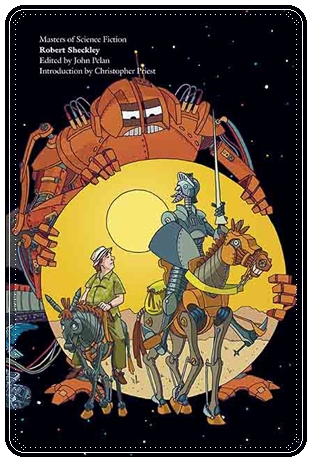
Book cover: “Masters of Science Fiction: Robert Sheckley” ed. John Pelan (Centipede Press, 2021)

A vast collection (33 stories, 700+ pages) in stately hardcover. The selection is representative, capturing Sheckley’s mastery, his near misses, and his distended bouts of abject self-indulgence. Never lacking for voice, Sheckley championed narrative informality and shifted the frontier of satirical SF.

The Robot Who Looked Like Me

The Robot Who Looked Like Me

by Robert Sheckley (Sphere, 1978)

Sheckley_The Robot Who Looked Like Me

A short fiction collection in which the reader is promised (and given) satire, inventiveness and humour, but also off-the-cuff storytelling, an intrusive sexual focus, a name writer’s complacency and maddening, devil-may-care flights of fancy that lead nowhere under the guise of surrealism.


Derelict Space Sheep