Category: 42 Word Retrospectives

The Memoirs of Sherlock Holmes

The Memoirs of Sherlock Holmes

by Sir Arthur Conan Doyle (George Newnes, 1893); audiobook ready by Stephen Fry (ABC, 2017)

Doyle_Memoirs Sherlock Holmes

Despite coming across as increasingly distant from modern times, these tales of Sherlock Holmes retain their appeal. Simply put, Holmes and Watson are great characters, and the mysteries themselves have a charm that rests enduringly in Conan Doyle’s (and Stephen Fry’s) telling.


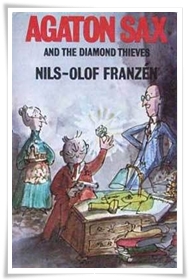
Agaton Sax and Lispington’s Grandfather Clock

Agaton Sax and Lispington’s Grandfather Clock

by Nils-Olof Franzén; ill. Quentin Blake (Andre Deutsch, 1978)

Franzen_Lispington's Grandfather Clock

The last of Franzén’s Agaton Sax books sees the great detective once again triumphant in the face of nefarious criminal undertakings, the harried mishaps of his good friend Inspector Lispington, and even the unfortunate magnetism of Andreas Kark. A fittingly ebullient finale.


The Fraxilly Fracas

The Fraxilly Fracas

by Douglas Hill (Victor Gollancz, 1989)

Hill_Fraxilly Fracas

By Hill’s standards, a great disappointment. Galactic courier Del Curb comes from the oeuvre of would-be comedic, self-inflated, mishap-prone, comeuppance-provoking space opera antiheroes. The story, however, fairly plods along and the humour is just a disreputable turkey flapping about, never taking flight.


All You Zombies and Other Stories

All You Zombies and Other Stories

by Robert A. Heinlein; audiobook read by Spider Robinson (Blackstone, 2014)

Heinlein_All You Zombies

Although lacking the plot progression, character arcs and no-frills brevity mandated by modern editors—for shame!—these five Heinlein stories demonstrate the engaging effect of powerful ideas wrapped in real narrative personality (and additionally, through Spider Robinson, a bona fide storyteller’s delivery).


The Nursing Home Murder

The Nursing Home Murder

by Ngaio Marsh (Geoffrey Bles, 1935); audiobook read by James Saxon (AudioGO, 2010)

Marsh_Nursing Home Murder

The nursing home (to the modern reader, operating theatre) murder is quite diverting once it gathers steam. Unfortunately, the first fifth of the book is groundwork. Inspector Alleyn—himself unimpeachable—is a late arrival and has to recover ground already laboriously trodden.


Mardoc

Mardoc

by Ronald A. McQueen (Hale, 1981)

McQueen_Mardoc

Unintentionally reactivated by a corrupt corporate government, a genetically engineered sleeper agent (think James Cameron’s Dark Angel) sets out to topple the established order. McQueen’s novel is a curious yet memorable mix of SF politics and super-powered insurgency. Intriguing, though plainly written.


Doctor Who: The Mind Robber

Doctor Who: The Mind Robber

by Peter Ling (Target, 1986); audiobook read by Derek Jacobi (BBC, 2010)

Ling_Mind Robber

Peter Ling’s only Doctor Who novelisation is more competently written than many in the Target range. As a Wonderland homage, however, and as a pioneering work of metatextualism, the story trots out (and bottoms out on) visual flourishes better suited to television.


Small Gods

Small Gods

by Terry Pratchett (Victor Gollancz, 1992); audiobook read by Nigel Planer (Isis, 1997)

Pratchett_Small Gods

Pratchett’s one-off Discworld novels were often rather special, and such is the case with this exposé on organised religion. The (formerly) Great God Om finds himself unwillingly manifested as a tortoise with only one follower. Nigel Planer is exquisite in his narration.


The Coming of the Fairies

The Coming of the Fairies

by Sir Arthur Conan Doyle (Hodder and Stoughton, 1922)

Doyle_Coming of the Fairies

It isn’t Doyle’s beliefs that grate in this tract; it’s his plodding insistence on presenting facts via formal correspondence. Even when addressing himself to the reader, Doyle assays a monotonous inveiglement, showing nothing of the literary warmth so beloved of his fiction.


Derelict Space Sheep