Category: 42 Word Retrospectives

The Man in the High Castle

The Man in the High Castle

by Philip K. Dick (Putnam, 1962); audiobook read by Jeff Cummings (Brilliance Audio, 2015)

Dick_Man High Castle

For all its philosophical musings on chance and Dick’s thoughtful concoction of an alternative history (post- World War II), ‘The Man in the High Castle’ is more manifesto than (Hugo-winning) novel. The vague confluence of characters hints at profundity where none exists.


Well Done, Secret Seven

Well Done, Secret Seven

by Enid Blyton (Brockhampton Press, 1951); audiobook read by Sarah Greene (BBC, 1998)

Blyton_Well Done Secret Seven

A simple little one-sitting mystery, which actually takes up less of the book than the children’s building of a treehouse. The Secret Seven think rather highly of themselves but here lack much by way of character – except for Scamper the Cocker Spaniel.


Colours in the Steel

Colours in the Steel

by K J Parker (Orbit, 1998)

Parker_Colours Steel

The original K J Parker novel, introducing all those elements—the detailed world building and practical intricacies, the tragedy-driven plots, hubris-plagued protagonists and gallows humour—that would prove characteristic of her/his work. Fencer lawyers make for the most apt of jumping-off points.


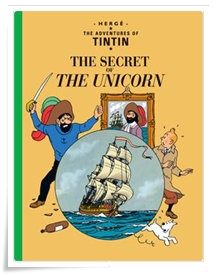
Tintin: The Secret of the Unicorn

Tintin: The Secret of the Unicorn

by Hergé (Methuen, 1959)

Herge_Secret Unicorn

Written during the German occupation of Belgium in World War II, The Secret of the Unicorn sees Hergé eschew political satire in favour of a well-constructed and comically sublime mystery/adventure. From nuances of expression to outrageous slapstick, Hergé here reaches new heights.


Fish Preferred

Fish Preferred

by P. G. Wodehouse (Doubleday, Doran, 1929); aka “Summer Lightning” (Herbert Jenkins, 1929); cf. “Pigs Have Wings” (Doubleday, 1952).

Wodehouse_Fish Preferred

Wodehouse duplicated this plot two decades later in writing ‘Pigs Have Wings’… but what a finely woven, artfully absurd plot it is (and what charm of prose that he could get away with it)! A bonhomous concatenation of deceptions, misunderstandings and pig-stealings.


Labyrinth

Labyrinth

dir. Jim Henson (1986)

Henson_Labyrinth

Henson tries to capture the same sense of whimsy as Alice in Wonderland, but—like most adaptors of that work—underwhelms. The delightful visuals and kooky ideas (and Bowie!) are offset by a rambling story and child acting lamentably of the 1980s.


Dark City

Dark City

dir. Alex Proyas (1998)

Proyas_Dark City

1940s noir in a SF/Halloween setting. Director Alex Proyas delivers Dark City’s scenario like a knife thrower, hurling mystery elements in quickfire until the plot takes shape. More accessible than Kafka; more coherent than Gilliam. Intelligent, atmospheric dystopia at its cinematic best.


Flash Gordon (1980)

Flash Gordon

dir. Mike Hodges (1980)

Hodges_Flash Gordon

Terribly scripted and more kinky than camp, with lavish costumes, cut-price model work, Queen’s SF rock soundtrack, and a bizarre mixture of quality actors and utter hams, tongue-in-cheek space opera Flash Gordon makes history as the most expensive B movie ever made.


Cat’s Cradle

Cat’s Cradle

by Kurt Vonnegut (Holt, Rinehart and Winston, 1963); audiobook read by Tony Roberts (HarperAudio, 2007)

Vonnegut_Cat's Cradle

To appreciate Vonnegut, one must concede to him the heightened facetiousness of Wodehouse within a satire less halcyon. Cat’s Cradle riffs on the everyday world turned sordidly askew, its protagonist forever teetering – either the only keeper or only inmate of the asylum.


The Hound of the Baskervilles

The Hound of the Baskervilles

by Arthur Conan Doyle (George Newnes, 1902); audiobook read by Stephen Fry (Audible, 2017)

Conan Doyle_Hound Baskervilles

Despite lacking its protagonist for extended periods and being little more complex a mystery than those of Conan Doyle’s short stories, The Hound of the Baskervilles sustains itself quite charmingly at novel length. The unhurried telling affords added solemnity to the narrative.


Derelict Space Sheep