Category: 42 Word Retrospectives

Tintin: The Broken Ear

Tintin: The Broken Ear

by Hergé (Casterman, 1943)

Herge_The Broken Ear

Tintin in this sixth book remains very much in his lucky reporter phase, barrelling with many an improbable escape through a convoluted, rather contrived mystery. That said, Hergé clearly delights in the action scenes and shows also his growing appreciation of satire.


Rusputin’s Revenge

Rusputin’s Revenge

by John Lescroart (Dutton, 1987); audiobook read by Tim Baltz (Brilliance Audio, 2011)

Lescroart_Rasputin's Revenge

A mystery rich in period detail but lacking a detective. Set in the Russia of Tsar Nicholas II, narrated by naïve French spy Jules Giraud and nominally featuring the son of Sherlock Holmes, this muddles along nicely enough until its absurd dénouement.


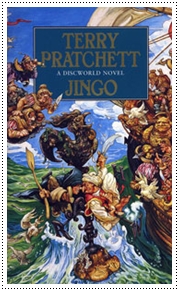
Jingo

Jingo

by Terry Pratchett (Victor Gollancz, 1997); audiobook read by Nigel Planer (Isis, 2000)

Pratchett_Jingo

Plotwise, Jingo ties itself in knots and threads. The humour is less overt than elsewhere in the Discworld canon, but there remains a droll, page-turning appeal in Pratchett’s railing against—with every weapon at his disposal, primarily Sam Vimes—humanity’s absurd jingoism.


Horton and the Kwuggerbug

Horton and the Kwuggerbug

by Dr. Seuss (HarperCollins, 2014)

Dr Seuss_Horton Kwuggerbug

These four ‘lost’ stories (ie. published originally in Redbook magazine in the 1950s, not in book form) show nascent elements of more-famous Dr. Seuss tales. Though slightly too wordy and more overtly moralising than Seuss’s early reader books, the illustrations remain masterful.


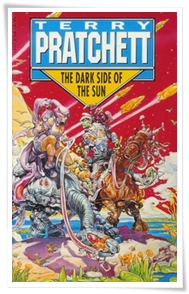
The Dark Side of the Sun

The Dark Side of the Sun

by Terry Pratchett (Colin Smythe, 1976); audiobook read by Stephen Briggs (Isis, 2007)

Pratchett_Dark Side of the Sun

Pre Discworld, pre Hitchhiker’s, Pratchett’s first (unrewritten) novel is a SF not-quite-comedy, rich in exotic detail and soaring with wild concepts… albeit not quite going anywhere. It is a tantalising glimpse into a universe where Pratchett parodied the future, not the present.


Money for Nothing

Money for Nothing

by P G Wodehouse (Herbert Jenkins, 1928); audiobook read by Jonathan Cecil (BBC, 2009)

Wodehouse_Money for Nothing

More or less the quintessential Wodehouse novel, with a country manor, a romance frustrated by misunderstanding, comings, goings, comedy mishaps, and several greedy protagonists locked in a tangle of one-upmanship, all exquisitely facetious in the telling, the prose gilded in its loquacity.


The Silmarillion

The Silmarillion

by J. R. R. Tolkien (Allen & Unwin, 1977); audiobook read by Martin Shaw (HarperCollins, 2015)

Tolkien_Silmarillion

A posthumously compiled addendum to Tolkien’s Middle-earth stories, demonstrating the epic imagination that underpinned these works but none of their narrative pull. In essence: a vast and proclamatory, untethered bore, which not even Martin Shaw’s sonorous narration can make worth persisting with.


Womble Stories

Womble Stories

by Elisabeth Beresford; audiobook read by Bernard Cribbins (BBC, 1976)

Beresford_Womble Stories

Six bite-sized Womble stories much in the vein of the five-minute TV episodes, read by Bernard Cribbins for a 1976 LP recording. By staying true to their personalities, various of the loveable, childlike Wombles stray briefly (and safely) into happily ended difficulties.


On Her Majesty’s Secret Service

On Her Majesty’s Secret Service

by Ian Fleming (Jonathan Cape, 1963); audiobook read by David Tennant (AudioGO, 2012)

Fleming_Her Majesty's Secret Service

Bond’s attitude to women remains unconscionable, but in other respects Fleming gives him a greater depth and vulnerability here than in other books (and certainly the films). The writing has refinement above its genre, and gains added respectability through David Tennant’s reading.


Derelict Space Sheep